Kyusho Jitsu - Vital points on the human body.
Kyusho Jitsu is an advanced study of vital and pressure points on the human body, combining the traditional knowledge of Eastern martial arts with insights into human anatomy, the nervous system and biomechanics. Its essence is not merely knowing where individual points are located, but above all understanding their anatomical context, their sensitivity and the way the human organism reacts to mechanical stimulation.
Advanced Kyusho Jitsu practitioners also become familiar with the principles of Traditional Chinese Medicine, in particular the teaching of Yin and Yang, the five elements theory (water, wood, fire, earth and metal) and the meridian system. Part of this traditional teaching consists of the generating (constructive), controlling and overcoming cycles, which describe the mutual relationships between the individual elements and organ systems.
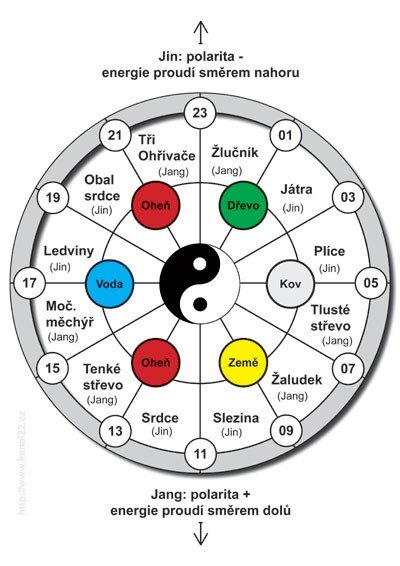
Another important area of study is the 24-hour meridian cycle, according to which each of the twelve main meridians has its own two-hour interval. These principles form the historical theoretical foundation of some schools of Kyusho Jitsu, although the existence of energy pathways and their time-dependent effects has not been proven by modern science.
From a practical point of view, precise knowledge of anatomy, the course of the nerves, muscle groups and sensitive areas of the human body is essential. In training, students study the importance of correct distance, timing, direction of applied force and technical execution. It is not always a matter of using maximum physical strength, but of the ability to apply the principles learned correctly under controlled conditions.
Kyusho Jitsu is thus an interesting extension of martial arts such as Karate, Jiu-Jitsu or Krav Maga, etc. It broadens practitioners' technical knowledge, deepens their understanding of the human body and supports more precise and effective execution of self-defence techniques. All practical training must take place safely and under the guidance of a qualified instructor.
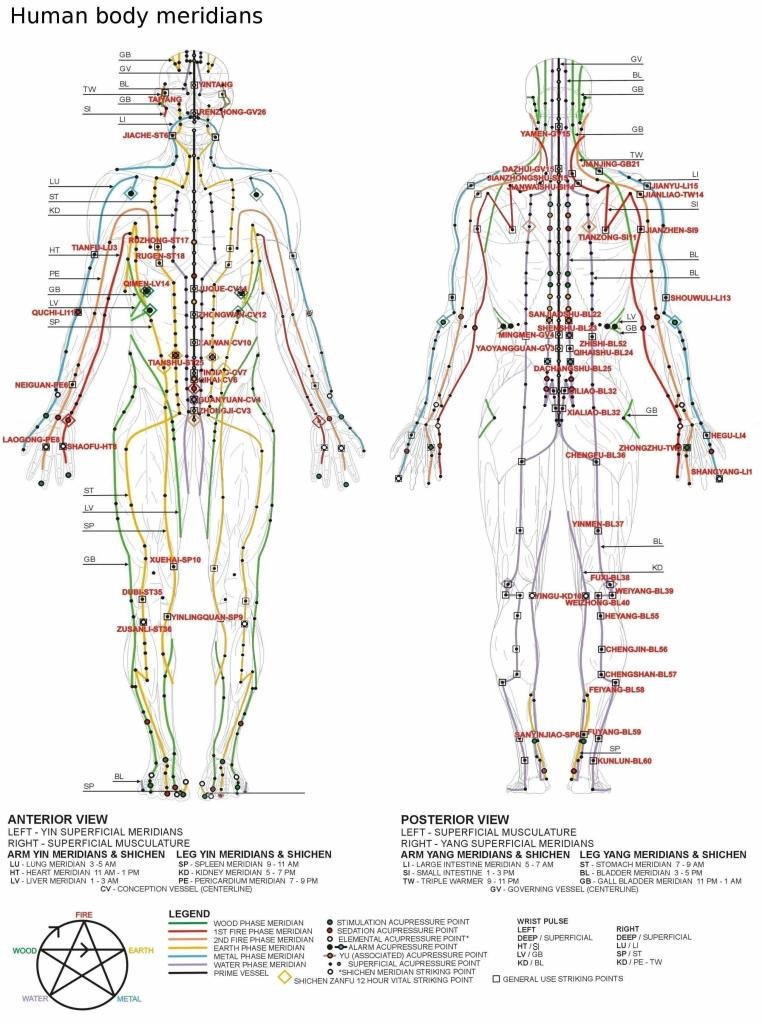 It is also necessary to know the basics of anatomy and the nerve pathways – where they run and where they end.
Kyusho students must certainly learn resuscitation/revival techniques, because this is essential – it is a matter of quickly restoring the affected energy fields and nerve pathways.
Kyusho attacks do not need to be particularly strong. On the contrary, a strike that is too strong will in many cases not achieve the best effect. This is why the system can be so effective for weaker people, such as women, children or elderly men.
A precise strike – one that combines several vital points in the right combination – causes an immediate energetic collapse.
Kyusho can play an important role in civilian self-defence or even in supporting health.
Warning! Kyusho may only be practised under proper professional supervision.
Meridians and their description:
About the energy currents - the meridians.
The energy in our body serves to protect our organs. Certain muscles are assigned to particular organs, and there is an energetic relationship between organs and muscles.
There is a great number of these pathways, but when working with energies, 12 main pathways are used, which are paired, together with two governing pathways, which are unpaired. In total, there are 26 energy pathways that make up the human energy system. Let us take a closer look at the individual pathways, including their characteristics.
The pathways, too, are divided according to the teaching of Yin and Yang into 6 paired Yin pathways and one unpaired Yin pathway, and likewise 6 paired Yang pathways and one unpaired Yang pathway. We can also speak of a major and a minor energy system, because the unpaired pathways are the governing pathways of both the Yin and the Yang pathways.
The unpaired (governing) pathways are the anterior median (Yin) and the posterior median (Yang). These unpaired pathways are referred to as the minor energy system, because by stimulating the anterior median pathway we indirectly stimulate all the Yin pathways, and by stimulating the posterior median pathway we indirectly stimulate all the Yang pathways. When we work on stimulating the 12 paired pathways, we speak of the major energy circuit. These are, however, merely auxiliary terms, since there are not two separate energy systems here, but only one, with the minor one being part of the major one.
The pathways are named after organs, and their affiliation with the individual elements (according to the Chinese pentagram) is likewise identical. Thus the Wood element is assigned the organs liver (Yin) and gallbladder (Yang), and in the same way the liver meridian (Yin) and the gallbladder meridian (Yang). It is similar with the other elements. So the Fire element comprises the heart and small intestine, plus the systemic organs and pathways of the pericardium and the Triple Energizer; the Earth element is assigned the pancreas-spleen and stomach; the Metal element the lungs and large intestine; and the Water element the kidneys and urinary bladder. The mutual relationships between the pathways are identical to the relationships between the organs, according to the Chinese pentagram.
We can imagine the meridians as electrical wiring with a precisely defined course. The meridians run 3 to 5 millimetres beneath the skin and at certain points come up to the surface. These are the so-called acupuncture points. Acupuncture is part of Traditional Chinese Medicine and its aim is to restore a state of health and energy balance in the organism.
If the twelve main energy pathways are not in perfect balance, nothing happens at first, but when this imbalance becomes permanent, an infection or illness may take a more complicated course than if our meridians were in order.
Balanced meridians help the body mobilise its self-healing powers and recover quickly again.
The meridians are like a closed energy circuit that constantly strives for balance in our body. It is important that we keep the function of our meridians in balance.
- Meridians are pathways through which energy flows. Each meridian and the points on it are related to a particular organ. When one of the acupuncture points is affected, whether by pressure, a strike or for health reasons (blocked), the proper flow of energy in the body is prevented, which leads to imbalance and may result in a knockout or give rise to health problems.
When selected points on a meridian are treated, the energy begins to flow again, the body returns to balance and is relieved of pain and other health problems. Pressure is applied to the points with the pad of the thumb or finger, but also with the elbow. One can press, squeeze intermittently, or use small circular massaging movements. This applies to treatment.
In attacks on vital points, the nervous system is affected; thanks to this art it is attacked in a particular way, and the angle and direction of the strike or pressure are the most important. As a rule, a soft part of the body is used to attack a hard part. Or the other way round.
The pathways are divided as follows:
The Yin pathways of the arms run, according to traditional teaching, from the chest area along the inner side of the upper limbs to the fingertips, where they end. These are the lung, pericardium and heart pathways. At the fingertips the Yang pathways of the arms take over, along which, according to the traditional system, the energy continues along the outer side of the upper limbs, across the shoulders and neck to the head. These pathways are called the small intestine meridian, the large intestine meridian and the Triple Energizer (Triple Burner) meridian.
From the head, according to the traditional model, the energy "flows down" along the long Yang pathways of the legs, which run across the back, trunk and outer parts of the legs to the tips of the toes. These are the gallbladder, stomach and urinary bladder pathways. An exception is the stomach pathway, which for part of its course runs along the front of the chest and abdomen, that is, areas traditionally associated with the principle of Yin.
From the tips of the toes the energy rises again towards the chest along the Yin pathways of the legs. These run mainly along the inner side of the legs, across the abdomen and chest. These are the kidney, liver and spleen–pancreas pathways. Here, according to traditional teaching, the energy again flows over into the Yin pathways of the arms, thus closing the entire energy circuit.
Each pathway has its own characteristics, a precisely described course and a certain number of acupuncture points. According to Traditional Chinese Medicine, each pathway is related to the organ whose name it bears, as well as to certain bodily functions. The individual points are located in various anatomical areas, for example near muscles, tendons, nerves and joints. We will discuss these characteristics and their significance for Kyusho Jitsu in more detail later.
The purpose of working with the meridians is, according to traditional teaching, to ensure their "patency" and to remove so-called energy blockages. According to this model, these are supposed to cause a lack of energy beyond the point of blockage and an excess of it before this point, in the direction of flow. In traditional methods, the pathways are stimulated, for example, by direct massage or acupressure, in which the described course of the individual meridians is followed in the order corresponding to the traditional flow of energy. Energy blockages are, however, not a scientifically confirmed anatomical phenomenon.
The flow of energy according to the traditional system is as follows:
Kidney meridian → pericardium meridian → Triple Energizer meridian → gallbladder meridian → liver meridian → lung meridian → large intestine meridian → stomach meridian → spleen–pancreas meridian → heart meridian → small intestine meridian → urinary bladder meridian → kidney meridian.
This completes the whole cycle, and according to traditional teaching it repeats.
The so-called organ clock also applies here, that is, a regular 24-hour schedule during which the individual pathways and organ systems, according to Traditional Chinese Medicine, reach their energetic maximum and minimum. These are two-hour cycles. In this model, the energetic minimum of each pathway is shifted by 12 hours relative to its maximum.
Meridians and proper nutrition
We should eat in a way that supports the natural functions of the organism and its overall balance. In Traditional Chinese Medicine and in some branches of kinesiology, proper nutrition is associated with maintaining the energetic harmony of the body. From the point of view of modern medicine, a balanced diet is important above all for the proper functioning of the organs, metabolism, regeneration and an adequate supply of nutrients.
We should realise that, in the traditional view, our organ clocks are a reflection of the organism's inner rhythms. According to this teaching, the energetic activity of the body shifts from one organ system to the next every two hours. We have twelve main energy pathways and the day has twenty-four hours.
During every two hours, according to the traditional system, the relevant meridian should be the most active. If there is a certain functional imbalance, Traditional Chinese Medicine sometimes links it with fatigue at a precisely defined time of day, waking at night, or conversely increased activity at certain hours.
Modern medicine explains these manifestations mainly by biological rhythms, hormonal regulation, sleep quality and other physiological processes. The traditional organ clock should therefore not be confused with scientifically confirmed biological clocks.
Hour – the energy pathway that is active according to the traditional system:
| Time | Energy pathway – meridian |
|---|---|
| 05:00–07:00 | Large intestine meridian |
| 07:00–09:00 | Stomach meridian |
| 09:00–11:00 | Spleen–pancreas meridian |
| 11:00–13:00 | Heart meridian |
| 13:00–15:00 | Small intestine meridian |
| 15:00–17:00 | Urinary bladder meridian |
| 17:00–19:00 | Kidney meridian |
| 19:00–21:00 | Pericardium meridian (circulation and sex) |
| 21:00–23:00 | Triple Energizer meridian – Triple Burner |
| 23:00–01:00 | Gallbladder meridian |
| 01:00–03:00 | Liver meridian |
| 03:00–05:00 | Lung meridian |
Note: The original time intervals were shifted by one hour. The standard division of the traditional Chinese organ clock is given here. These are not scientifically confirmed times of maximum physiological activity of the individual organs.
Shifting of the meridians
There are people whose internal clocks are shifted by several hours. Some traditional interpretations speak, for example, of a shift of three meridians backwards. These people tend to be alert mainly in the evening, get hungry late at night and often feel no need to go to bed, even though they feel tired during the day. They calm down only around midnight or later.
When changing time zones or switching to summer and winter time, we may perceive these changes even more strongly. From the point of view of modern medicine, this is mainly a matter of differences in a person's chronotype and of the adjustment of the biological clock to a new daily routine.
Meridians and internal clocks
According to Traditional Chinese Medicine, the internal organ clocks arise from the natural interplay of the individual organs and meridians. Their mutual cooperation is, according to this teaching, meant to ensure the harmonious functioning of the organism throughout the day.
We must always bear in mind that processing food requires a certain amount of energy. Food must first be broken down, digested and the individual nutrients absorbed. In this process the organism consumes energy, but at the same time obtains it from the food taken in. The speed at which energy is used depends on the composition of the meal, on metabolism and on other factors.
This is precisely what our current eating habits, the regularity of food intake and the correct timing of meals are connected with. For martial arts practitioners, nutrition is also important in terms of physical performance, concentration, regeneration and the ability to cope with demanding training.
Each meridian pathway has a certain number of traditionally described acupuncture points. In martial arts and Kyusho Jitsu, mainly selected points are used, whose location and anatomical context are part of advanced study. Some traditional schools also work with combinations of points from the main and associated organ systems. Precision and correct timing are important technical principles, but no combination guarantees a one hundred per cent knockout, and strikes leading to loss of consciousness represent a serious health risk.
Warning: Kyusho Jitsu training must take place under the guidance of a qualified instructor. Incorrectly performed or uncontrolled strikes to sensitive anatomical areas of the human body can cause serious injury, permanent health consequences and, in extreme cases, even death. It is therefore essential to observe strict safety rules and the principles of responsible training.
Gallbladder meridian (GB) – Gallbladder Meridian
Number of points: 44 (GB1–GB44) on each side of the body
Element: Wood (Yang)
Paired meridian: Liver (Yin)
Generating element: Fire
Controlled element: Earth
Organ clock: 23:00–01:00
Course of the meridian
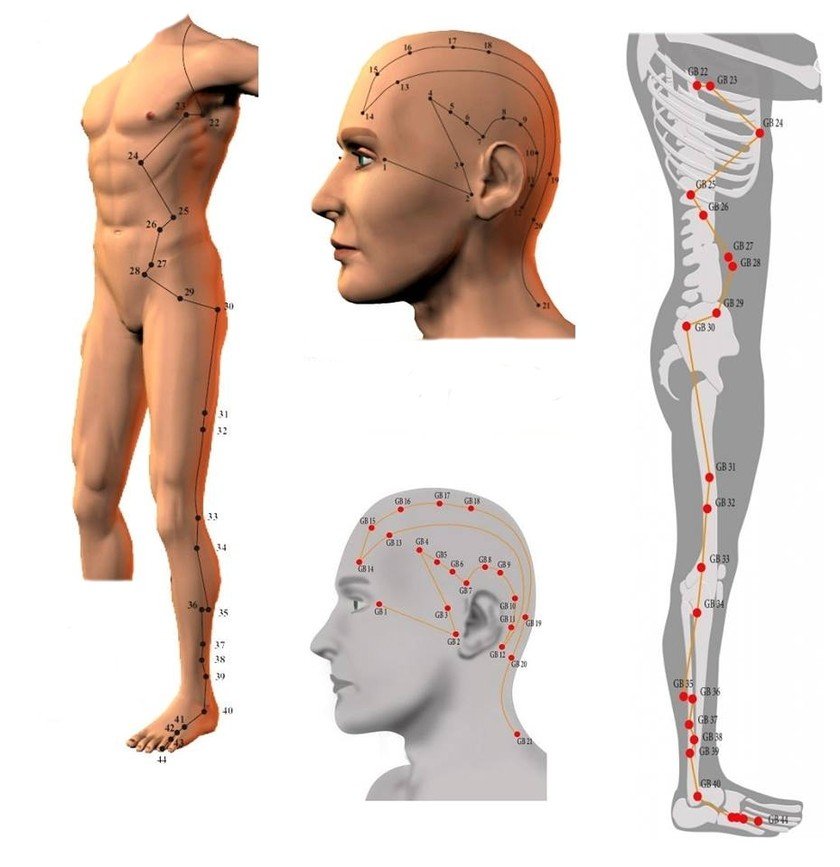
The gallbladder meridian is a Yang meridian that begins at the outer corner of the eye. From there it crosses the temple region in a complex pattern, continues around the ear, over the back of the head, the neck and the shoulder. It then runs along the side of the chest, ribs and abdomen, continues across the outer hip region, along the outer side of the thigh and lower leg to the foot. It ends at the outer edge of the nail bed of the fourth toe.
In total it contains 44 traditionally designated acupuncture points, which in the international system are denoted by the abbreviation GB and the numbers 1 to 44.
Significance of the meridian in Kyusho Jitsu
The gallbladder meridian is one of the important meridians studied in Kyusho Jitsu. Its traditional points are located in anatomically distinct areas that include muscle groups, nerve branches, tendons, joints and other sensitive structures of the human body.
Advanced practitioners learn to recognise the individual points, their traditional designations and their anatomical context. An important part of the training is understanding the reactions of the nervous system to mechanical stimuli, reflex responses, muscle tension and biomechanical principles.
Traditional schools of Kyusho Jitsu also study the mutual combinations of points and their relationships according to the principles of Yin and Yang and the five elements. These historical theories, however, must not be confused with scientifically confirmed mechanisms of action on the human organism.
Principles of use in martial arts
Kyusho Jitsu places emphasis above all on precision, timing, control of distance and correct movement biomechanics. Knowledge of anatomy makes it possible to better understand the techniques used in Karate, Jiu-Jitsu, Krav Maga and other self-defence systems.
The ability to connect knowledge of vital points with techniques already learned plays a significant role, for example when releasing grips, controlling an opponent's movement or performing defensive techniques.
Traditional relationships of the five elements
The gallbladder meridian belongs, together with the liver meridian, to the Wood element. In the traditional generating cycle Wood nourishes Fire, and in the controlling cycle it acts on Earth.
These relationships are among the basic theoretical principles of some schools of Kyusho Jitsu and help to explain the traditional system of interconnection between the individual meridians.
Warning: Kyusho Jitsu training must take place under the guidance of a qualified instructor. Strikes to sensitive anatomical areas can cause serious injury, and it is therefore essential to observe safety rules.
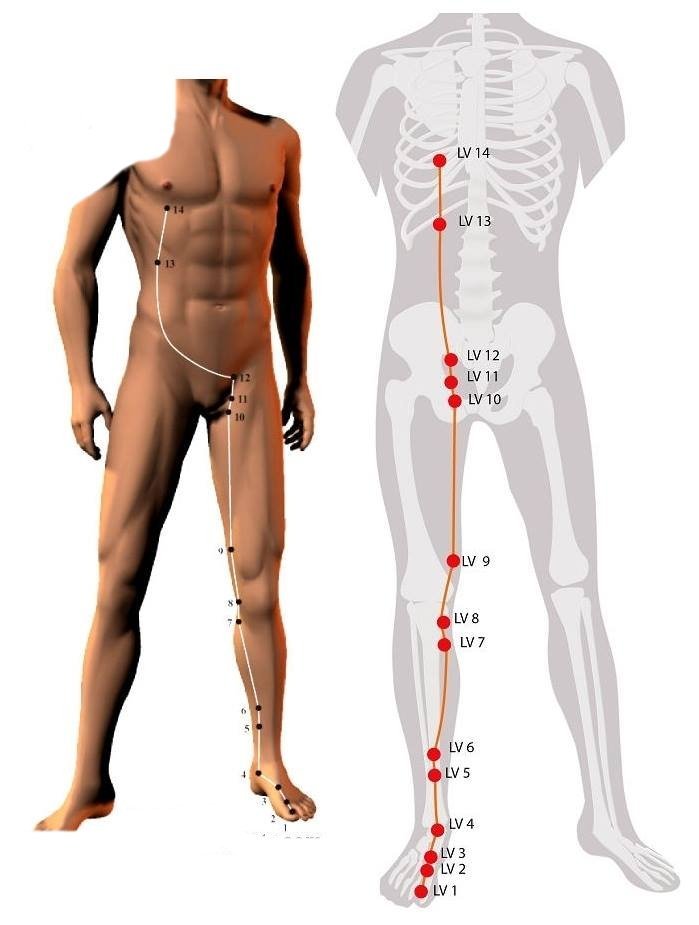
Liver meridian (LV) – Liver Meridian
Number of points: 14 (LV1–LV14) on each side of the body
Element: Wood (Yin)
Paired meridian: Gallbladder (Yang)
Generating element: Fire – Wood nourishes Fire
Controlled element: Earth – Wood controls Earth
Organ clock: 01:00–03:00
Course of the meridian
The liver meridian is one of the Yin meridians of the lower limbs. It begins at point LV1 by the nail bed of the big toe, on the side facing the second toe. From there it continues over the instep, the inner ankle and up along the inner side of the lower limb.
It passes through the region of the knee and thigh, continues across the groin, lower abdomen and abdominal wall up to the chest. Its superficial course ends at point LV14 in the sixth intercostal space, approximately in line with the mid-clavicular line.
The meridian contains a total of 14 traditionally described acupuncture points, denoted by the international abbreviation LV (Liver) and the numbers LV1 to LV14.
Significance of the meridian in Kyusho Jitsu
In Kyusho Jitsu the liver meridian is an important part of the study of the Yin meridians. Its traditional points are located in the areas of the lower limbs, pelvis, abdomen and chest, where they lie close to various muscular, nerve and tendon structures.
From an anatomical point of view, knowledge of the muscles of the lower limbs, joint mobility, nerve pathways and movement biomechanics is particularly important for practitioners. Studying these relationships helps in understanding the principles of stance stability, balance and the transfer of body weight.
In traditional Kyusho Jitsu the liver meridian is also studied in relation to the gallbladder meridian, with which it forms the Yin–Yang pair of the Wood element.
Advanced practitioners become familiar with traditional combinations of points, their designations and relationships according to the principles of the five elements. At the same time it is important to understand the actual anatomical structures and physiological reactions of the human body.
Traditional characteristics and physical manifestations of imbalance
According to Traditional Chinese Medicine, the liver meridian is associated with regulating the flow of life energy Qi, the condition of the tendons, muscle tension, the eyes and the overall flexibility of the organism.
Traditional teaching links energetic imbalance of this meridian with a range of physical and functional complaints.
Digestive system: Loss of appetite, digestive disorders, vomiting, constipation, diarrhoea, feelings of fullness or pressure under the ribs, and increased fatigue.
Head and sensory organs: Headaches, ringing in the ears, blurred vision, dry eyes and unpleasant sensations around them.
Muscles, tendons and musculoskeletal system: Muscle cramps, increased tension of the tendons, pain in the joints, connective tissue and sacral area. In the traditional view, difficulty bending the trunk forwards and backwards is also listed.
Urinary and reproductive system: Urinary disorders, bedwetting, difficulty emptying the bladder, swelling in the scrotal area in men or the lower abdomen in women.
Skin, nails and hair: Dry skin, a dull to ashen complexion, soft and brittle nails or hair without natural shine.
These manifestations derive from the traditional description of the meridian and are not in themselves proof of its energetic disturbance or of liver disease. The health complaints listed may have various medical causes.
Principles of use in martial arts
In Kyusho Jitsu, knowledge of the liver meridian is linked primarily with the study of anatomy, neuromuscular reactions and biomechanical principles.
In Karate, Jiu-Jitsu and Krav Maga training, this knowledge can complement an understanding of movement mechanisms, balance control, work with the centre of gravity and self-defence techniques.
Emphasis is placed on the precision of technical execution, correct timing and the ability to use the movement of one's own body effectively without needlessly relying on brute force.
Traditional relationships of the five elements
The liver meridian belongs, together with the gallbladder meridian, to the Wood element.
In the generating cycle Wood nourishes Fire, while in the controlling cycle Wood controls Earth.
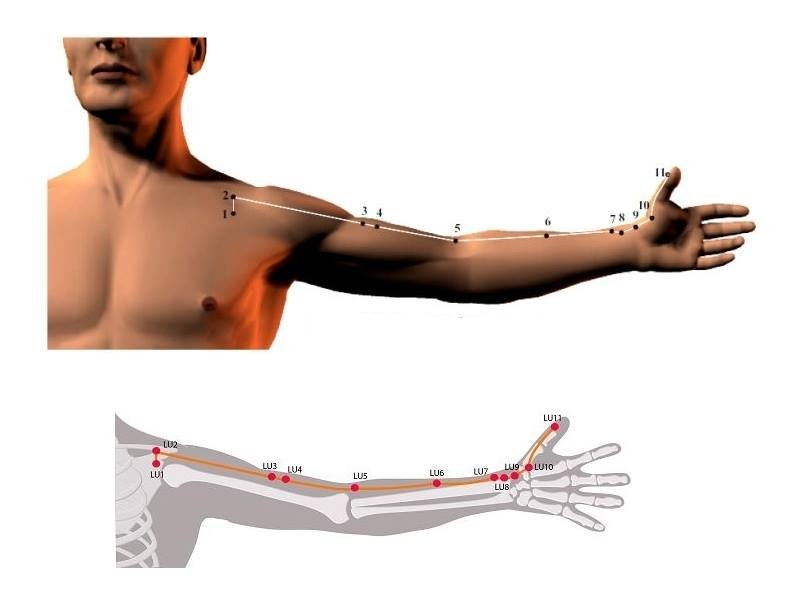
Lung meridian (LU) – Lung Meridian
Number of points: 11 (LU1–LU11) on each side of the body
Element: Metal (Yin)
Paired meridian: Large intestine (Yang)
Generating element: Water – Metal nourishes Water
Controlled element: Wood – Metal controls Wood
Organ clock: 03:00–05:00
Course of the meridian
The lung meridian is one of the Yin meridians of the upper limbs. According to traditional Chinese teaching, its internal branch begins in the middle part of the trunk, descends to the large intestine, returns to the stomach region, passes through the diaphragm and enters the lungs. From there it continues towards the trachea and throat.
The superficial part of the pathway begins in the upper chest, near the second rib, from where it descends along the front and outer side of the arm in the region of the biceps. It then continues along the thumb side of the forearm across the wrist to the thumb, where it ends at point LU11 by the outer edge of the nail bed.
In total it contains 11 traditionally described acupuncture points, denoted by the international abbreviation LU (Lung).
Significance of the meridian in Kyusho Jitsu
The lung meridian is an important part of the study of vital points of the upper limbs. In Kyusho Jitsu, attention is focused mainly on the anatomical context of the individual points, their location near nerve branches, muscles, tendons and other sensitive structures.
Knowledge of the anatomy of the upper limbs helps practitioners better understand the principles of grips, joint locks, escaping from holds and controlling an opponent's movement. The biomechanics of the shoulder and elbow joints, the wrist and the thumb also plays an important role.
Traditional schools of Kyusho Jitsu also study combinations of individual points, their mutual relationships and their connections with other meridians according to the principles of Yin and Yang and the five elements.
Traditional characteristics and physical manifestations of imbalance
According to Traditional Chinese Medicine, the lung meridian is associated primarily with breathing, the body's defensive functions, the skin and the regulation of life energy Qi.
Energetic imbalance of this pathway is traditionally associated with coughing, asthma, shortness of breath, pressure in the chest, sore throat, chills, increased sensitivity to cold, dry and rough skin, eczema, and pain in the shoulders, forearms or wrists.
These manifestations represent the traditional characteristics of the meridian, not confirmation of a specific disease or disturbance of the energy pathway.
Principles of use in martial arts
Emphasis is placed on precision of movement, correct timing, control of distance and the use of anatomical and biomechanical principles. Knowledge of the sensitive areas of the upper limbs can broaden understanding of control techniques, escaping from grips and working with the opponent's balance.
Traditional relationships of the five elements
The lung meridian belongs, together with the large intestine meridian, to the Metal element.
In the generating cycle Metal nourishes Water, while in the controlling cycle Metal controls Wood.
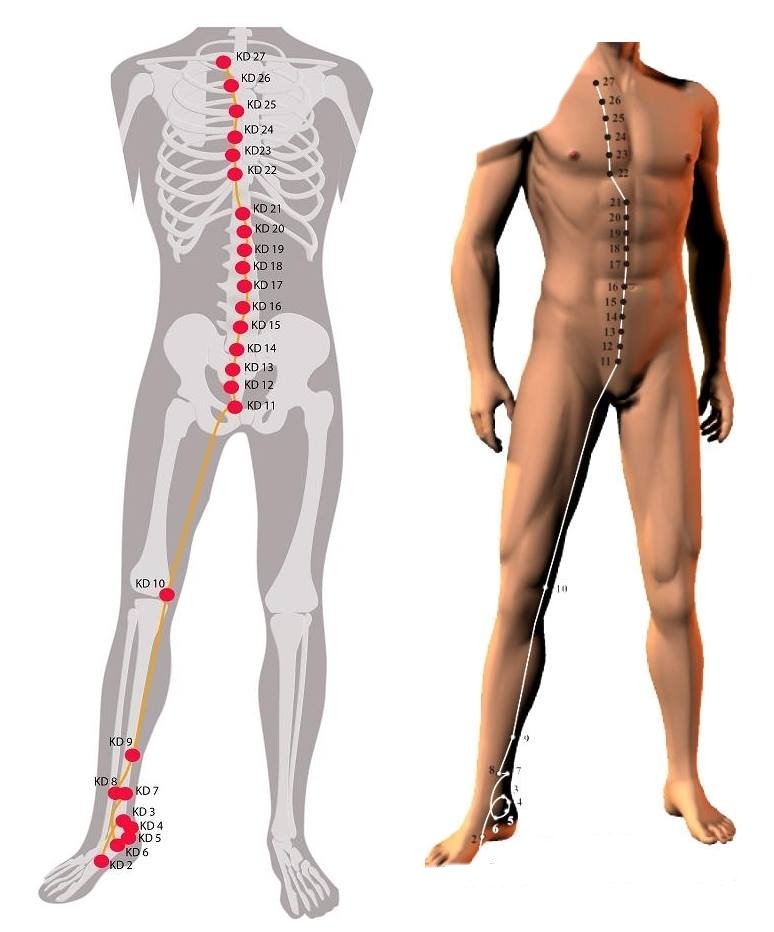
Kidney meridian (KI) – Kidney Meridian
Number of points: 27 (KI1–KI27) on each side of the body
Element: Water (Yin)
Paired meridian: Urinary bladder (Yang)
Generating element: Wood – Water nourishes Wood
Controlled element: Fire – Water controls Fire
Organ clock: 17:00–19:00
Course of the meridian
The kidney meridian is one of the Yin meridians of the lower limbs. It begins at point KI1 (Yongquan) on the sole of the foot, approximately in the front third of the foot. In traditional acupressure this point is associated with releasing tension and calming the organism.
From there the pathway continues along the inner side of the foot, winds around the inner ankle and rises along the inner side of the lower leg and thigh. It then passes through the pelvis, lower abdomen and the front wall of the abdomen, continues across the chest and ends at point KI27 just below the collarbone, near the breastbone.
The meridian contains a total of 27 traditionally described acupuncture points, denoted by the international abbreviation KI (Kidney).
Significance of the meridian in Kyusho Jitsu
In traditional Kyusho Jitsu the kidney meridian is studied mainly in connection with the sensitive points of the lower limbs, feet and trunk. Its course includes anatomical areas important for stance stability, balance, hip movement and coordination of the lower limbs.
From an anatomical point of view, knowledge of the muscles, tendons, nerve branches and joint structures located near the individual traditional points is important.
In some Kyusho schools the kidney meridian is also studied in conjunction with the urinary bladder meridian and their mutual relationships according to the principles of Yin and Yang. These relationships form part of the traditional system of point combinations and the five elements.
Traditional characteristics and physical manifestations of imbalance
According to Traditional Chinese Medicine, the kidney meridian is associated with vitality, growth, reproductive functions, the bones and overall life energy.
Energetic imbalance of this pathway is traditionally associated with fatigue, pain in the lumbar region, a feeling of heavy legs, swelling of the lower limbs, urinary disorders, menstrual and sexual difficulties, digestive problems, dark circles under the eyes, dry skin and some breathing difficulties.
These manifestations represent the traditional characteristics of the meridian and in themselves do not demonstrate a disorder of kidney function or of the energy pathway.
Traditional relationships of the five elements
The kidney meridian belongs, together with the urinary bladder meridian, to the Water element.
In the generating cycle Water nourishes Wood, while in the controlling cycle Water controls Fire.
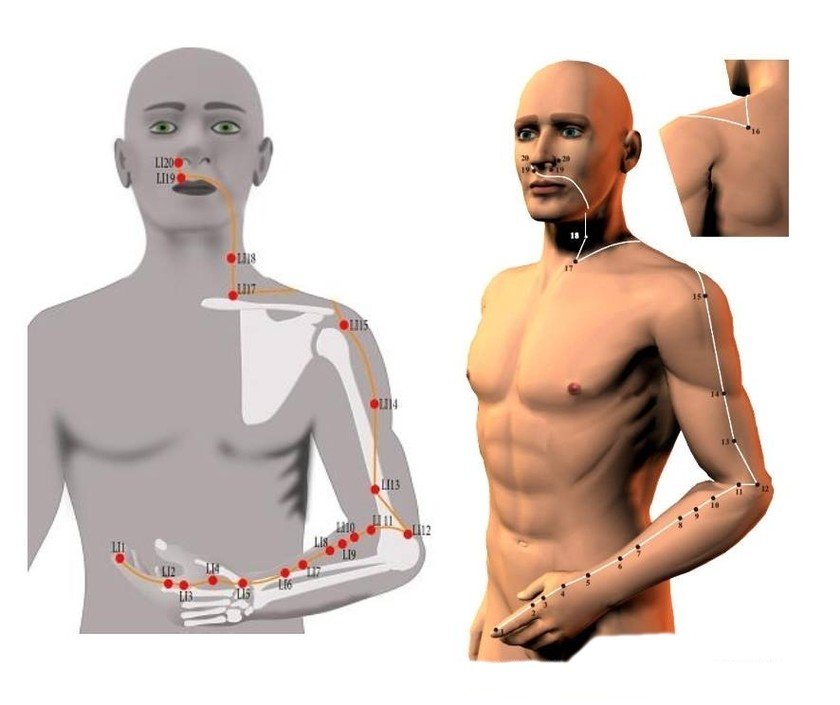
Large intestine meridian (LI) – Large Intestine Meridian
Number of points: 20 (LI1–LI20) on each side of the body
Element: Metal (Yang)
Paired meridian: Lung (Yin)
Generating element: Water – Metal nourishes Water
Controlled element: Wood – Metal controls Wood
Organ clock: 05:00–07:00
Course of the meridian
The large intestine meridian is one of the Yang meridians of the upper limbs. It begins at point LI1 on the thumb side of the nail bed of the index finger. From there it continues along the back of the hand, across the wrist and along the outer side of the forearm towards the elbow.
It then rises along the outer side of the upper arm over the shoulder, continues into the neck and lower jaw region. It passes around the mouth, crosses the midline of the face and ends at point LI20 in the nasolabial fold beside the wing of the nose on the opposite side of the face.
The meridian contains a total of 20 traditionally described acupuncture points, denoted by the international abbreviation LI (Large Intestine).
Significance of the meridian in Kyusho Jitsu
The large intestine meridian is one of the important meridians studied in Kyusho Jitsu, particularly because of the location of its traditional points in the areas of the hand, forearm, upper arm, shoulder, neck and face.
From an anatomical point of view, knowledge of the course of the superficial nerve branches, muscle groups, tendons and joint structures is important. Some points are located in areas with increased sensitivity to mechanical stimuli, which is the subject of the study of neuromuscular and reflex reactions.
Special attention is paid to the anatomy of the hand and forearm, the function of grip, the mobility of the wrist and elbow and the connections between muscle tension and control of movement.
Traditional schools of Kyusho Jitsu also study the relationships of the points of the large intestine meridian with its Yin counterpart, the lung meridian, and with other pathways according to the five elements system.
Traditional characteristics and physical manifestations of imbalance
According to Traditional Chinese Medicine, the large intestine meridian is associated with elimination, the functions of the digestive system, the mucous membranes and the area of the nose, mouth and throat.
Energetic imbalance of this pathway is traditionally associated with constipation, diarrhoea, abdominal pain, toothache and neck pain, nosebleeds, a runny nose, allergic reactions, skin complaints and tenderness along the course of the upper limb.
These manifestations derive from traditional teaching and in themselves do not confirm a disturbance of the meridian or any specific disease.
Traditional relationships of the five elements
The large intestine meridian belongs, together with the lung meridian, to the Metal element.
In the generating cycle Metal nourishes Water, while in the controlling cycle Metal controls Wood.
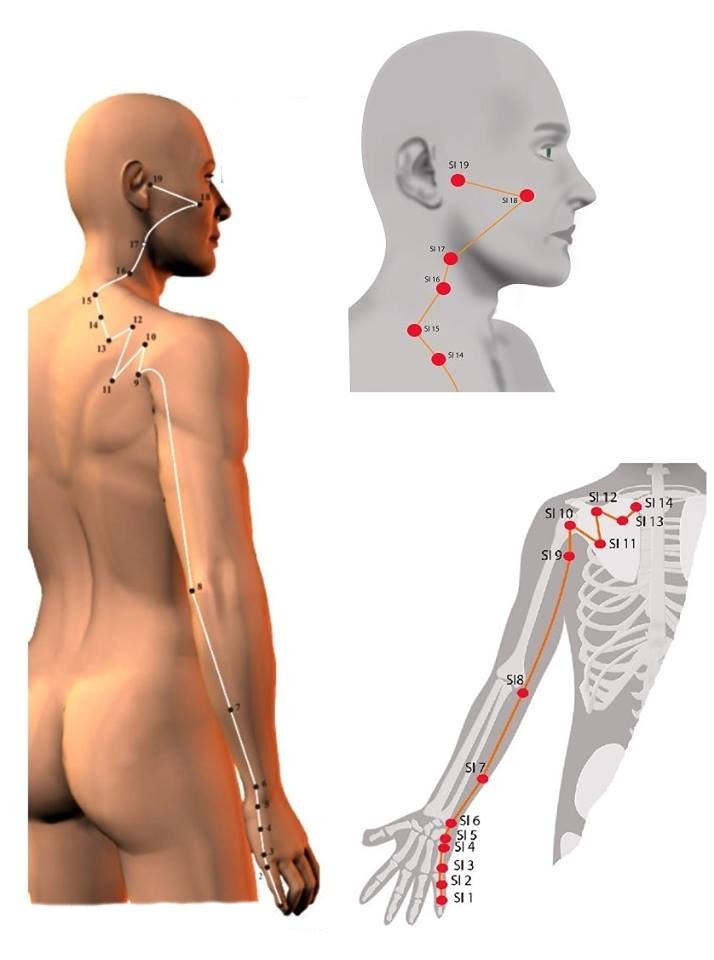
Small intestine meridian (SI) – Small Intestine Meridian
Number of points: 19 (SI1–SI19) on each side of the body
Element: Fire (Yang)
Paired meridian: Heart (Yin)
Generating element: Earth – Fire nourishes Earth
Controlled element: Metal – Fire controls Metal
Organ clock: 13:00–15:00
Course of the meridian
The small intestine meridian is one of the Yang meridians of the upper limbs. It begins at point SI1 by the outer edge of the nail bed of the little finger, on the side facing the ulnar edge of the hand. From there it continues along the little-finger side of the hand, across the wrist and the posterior inner part of the forearm towards the elbow.
It then rises along the back of the upper arm, passes through the region of the shoulder joint and shoulder blade, from where it continues across the side of the neck to the lower jaw and cheek. Its superficial course ends at point SI19 in front of the ear, in the region of the jaw joint.
The meridian contains a total of 19 traditionally described acupuncture points, denoted by the international abbreviation SI (Small Intestine).
Significance of the meridian in Kyusho Jitsu
In Kyusho Jitsu the small intestine meridian is significant mainly for the study of sensitive points of the upper limbs, the shoulder girdle and the head region.
From an anatomical point of view, knowledge of the course of the nerve branches, muscle attachments, tendons and joint structures is important. Attention is paid in particular to the function of the ulnar nerve, the mobility of the shoulder joint, the muscles of the shoulder blade and their mutual cooperation in the movement of the upper limb.
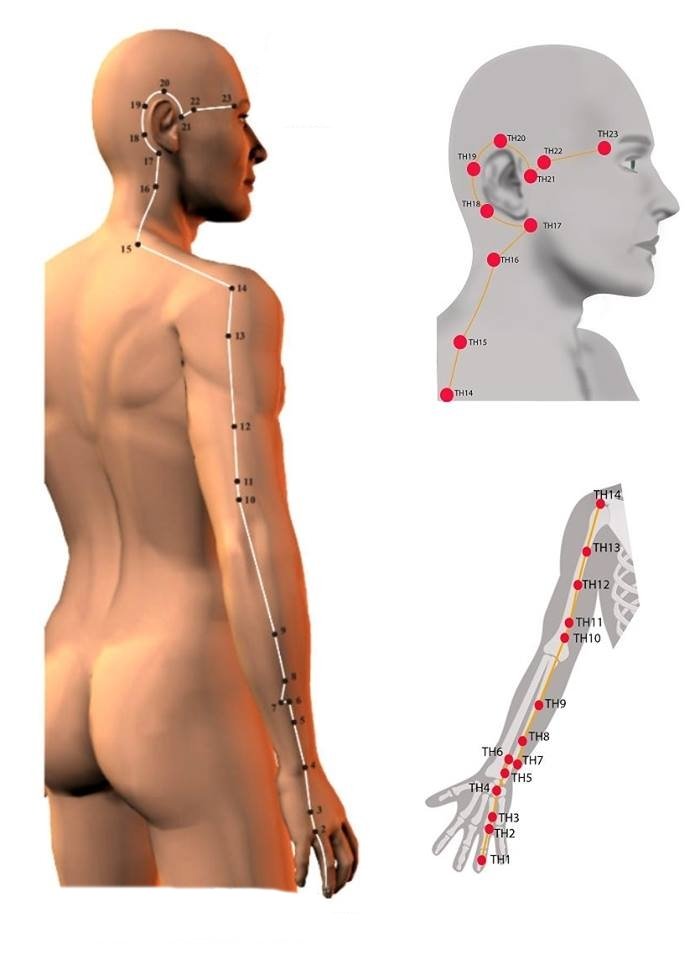
Triple Energizer meridian (TE) – Triple Energizer Meridian
Number of points: 23 (TE1–TE23) on each side of the body
Element: Fire (Yang)
Paired meridian: Pericardium – heart protector (Yin)
Generating element: Earth – Fire nourishes Earth
Controlled element: Metal – Fire controls Metal
Organ clock: 21:00–23:00
Course of the meridian
The Triple Energizer meridian, also called the Triple Burner (San Jiao), is one of the Yang meridians of the upper limbs. It begins at point TE1 by the nail bed of the ring finger, on the side facing the little finger. From there it continues along the back of the hand, across the wrist and along the back of the forearm between the ulna and the radius.
It then rises across the elbow, the back of the upper arm and the shoulder, continues across the neck region to the ear, which it goes around, and subsequently heads towards the temple region. Its superficial course ends at point TE23 at the outer end of the eyebrow.
The meridian contains a total of 23 traditionally described acupuncture points, denoted by the international abbreviation TE (Triple Energizer), or SJ (San Jiao).
Significance of the meridian in Kyusho Jitsu
In Kyusho Jitsu the Triple Energizer meridian is significant mainly in the study of sensitive points of the upper limbs, the shoulder girdle and the head region.
From an anatomical point of view, knowledge of nerve branches, muscles, tendons and joint structures is important. Special attention is paid to the anatomy of the forearm, the elbow and shoulder joints, the coordination of the upper limbs and the reactions of the nervous system to mechanical stimuli.
Traditional schools of Kyusho Jitsu also study the Triple Energizer meridian in relation to the pericardium meridian, with which it forms the Yin–Yang pair of the Fire element.
Traditional characteristics and physical manifestations of imbalance
In Traditional Chinese Medicine the Triple Burner is a functional system, not a separate anatomical organ. It is divided into three regions:
-
Upper burner: Related mainly to the functions of the heart and lungs, breathing and blood circulation.
-
Middle burner: Associated with the stomach, spleen, digestion and the processing of food.
-
Lower burner: Related to the kidneys, urinary bladder, elimination and reproductive functions.
According to Traditional Chinese Medicine, energetic imbalance of this pathway is associated with pain in the head, ears, teeth, nape and shoulders, ringing in the ears, hearing disorders, swelling of the face, pain in the joints of the upper limbs, digestive complaints and urinary disorders. Traditional descriptions also mention links with blood circulation, breathing and the function of the reproductive organs.
These manifestations derive from traditional teaching and in themselves do not confirm a disturbance of the meridian or any specific disease.
Traditional relationships of the five elements
The Triple Energizer meridian belongs, together with the pericardium meridian, to the Fire element.
In the generating cycle Fire nourishes Earth, while in the controlling cycle Fire controls Metal.
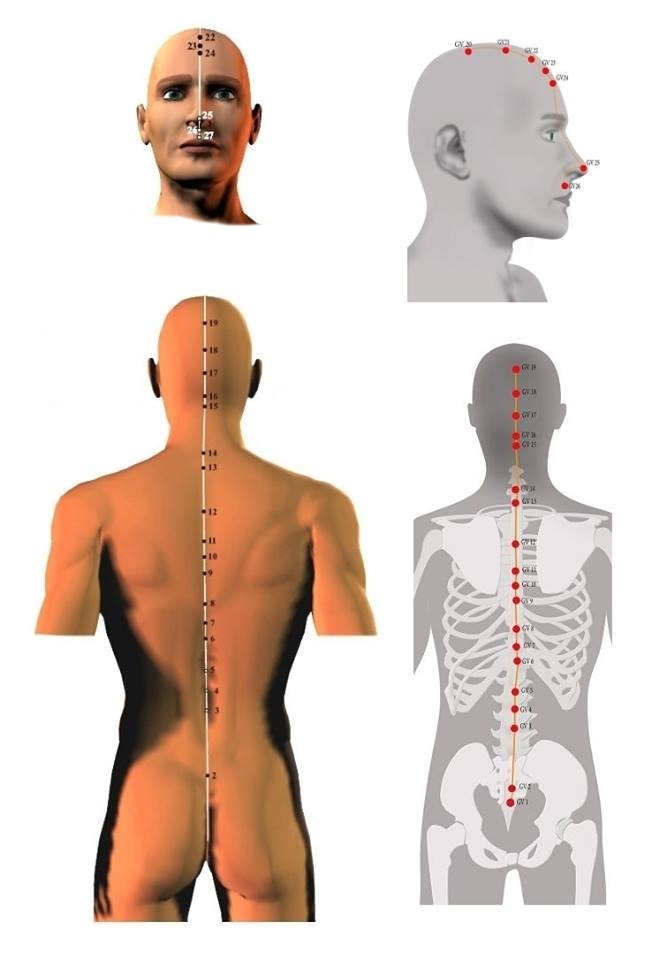
Posterior median meridian (GV/DU) – Governing Vessel
Number of points: 27 (GV1–GV27)
Characteristics: Unpaired, governing pathway (Yang)
Traditional name: Du Mai – governing vessel
Paired governing pathway: Anterior median meridian (Ren Mai – Yin)
Course of the meridian
The posterior median meridian is one of the main governing pathways of the traditional meridian system. It is unpaired and runs along the midline of the back of the human body.
It begins at point GV1 between the coccyx and the anus, from where it rises along the spine across the lumbar, thoracic and cervical regions to the back of the head. It then continues over the crown of the head, the forehead and the bridge of the nose towards the upper lip. It ends at point GV28 on the frenulum of the upper lip, at the place where it joins the upper gum.
The pathway contains a total of 28 traditionally described points, denoted by the abbreviation GV (Governing Vessel) or DU (Du Mai).
Significance of the meridian in Kyusho Jitsu
The posterior median meridian has exceptional significance in traditional Kyusho Jitsu. According to Eastern teaching, it is one of the main governing pathways, which connects and influences the Yang meridians of the human body.
From an anatomical point of view, its traditional course lies in areas important for the functioning of the central nervous system, the musculoskeletal system and the maintenance of bodily balance.
In the study of Kyusho Jitsu, knowledge of the structure of the spine, the spinal cord, the nerve roots, the muscles of the back and neck and the anatomy of the skull is important. This knowledge helps in understanding stance stability, posture, coordination of movement and biomechanical principles.
Some traditional points of this pathway lie close to exceptionally sensitive anatomical structures, so studying them requires a high level of expert knowledge.
Traditional characteristics and physical manifestations of imbalance
According to Traditional Chinese Medicine, the posterior median meridian is associated with the regulation of Yang energy, the spine, the brain and the nervous system.
Energetic imbalance of this pathway is traditionally associated with pain and stiffness of the spine, headaches, dizziness, muscle cramps, sleep disorders, irritability, some eye and nose complaints, and disorders of digestion and of the reproductive functions.
These manifestations derive from traditional teaching and in themselves do not demonstrate a disturbance of the meridian or any specific disease.
Relationship to the other meridians
The posterior median meridian Du Mai is referred to in Traditional Chinese Medicine as the "Sea of Yang Meridians", because it is associated with the regulation of Yang energy in the organism.
Together with the anterior median meridian Ren Mai it forms the basis of the traditional system of governing pathways. Whereas Du Mai is associated with the principle of Yang, Ren Mai represents the principle of Yin.
These two pathways also hold a significant position in the traditional study of Kyusho Jitsu and in the theory of the mutual relationships between the individual meridians.
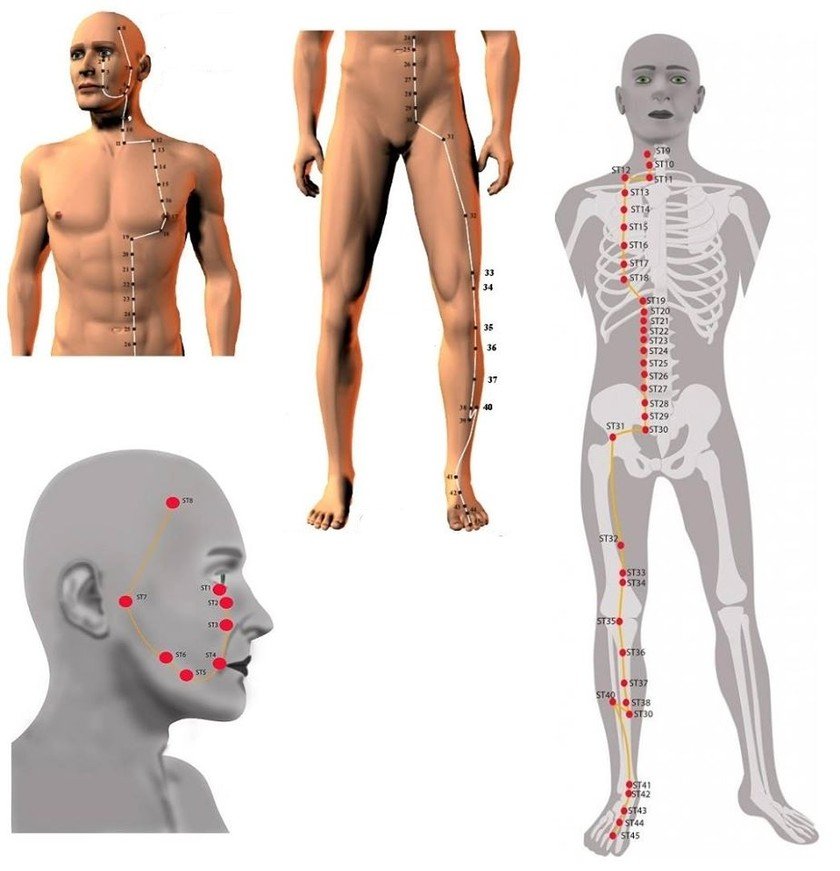
Stomach meridian (ST) – Stomach Meridian
Number of points: 45 (ST1–ST45) on each side of the body
Element: Earth (Yang)
Paired meridian: Spleen–pancreas (Yin)
Generating element: Metal – Earth nourishes Metal
Controlled element: Water – Earth controls Water
Organ clock: 07:00–09:00
Course of the meridian
The stomach meridian is one of the Yang meridians of the lower limbs. It begins at point ST1 below the eye, from where it continues across the cheek, upper and lower jaw. One part of the pathway heads towards the temple region and forehead, while the main branch descends across the neck, the front of the chest and the abdomen.
It then continues across the groin and the front of the thigh, knee and lower leg. Across the instep it heads to the second toe, where it ends at point ST45 by the outer edge of the nail bed.
In total it contains 45 traditionally described acupuncture points, denoted by the international abbreviation ST (Stomach).
Significance of the meridian in Kyusho Jitsu
The stomach meridian is one of the important meridians studied in Kyusho Jitsu. Its points are located in anatomically important areas, which include the facial muscles, nerve branches, and the muscles of the trunk and lower limbs.
From an anatomical point of view, knowledge of the trigeminal nerve (nervus trigeminus) in the facial region, the structure of the jaw apparatus, the muscles of the abdominal wall and the neuromuscular structures of the lower limbs is particularly important.
In the study of Kyusho Jitsu, attention is also paid to movement biomechanics, stance stability, the transfer of body weight and the reflex reactions of the organism.
Well-known points of this meridian include, for example, ST6 (Jiache), ST9 (Renying) and ST36 (Zusanli). Studying them covers their traditional designation, anatomical location and safety considerations. Some of these areas contain exceptionally sensitive vascular and nerve structures.
Traditional characteristics and physical manifestations of imbalance
According to Traditional Chinese Medicine, the stomach meridian is associated primarily with digestion, the processing of food, the nourishment of the organism and the functions of the digestive system.
Energetic imbalance of this pathway is traditionally associated with abdominal pain, nausea, vomiting, loss of appetite, digestive complaints, pain in the head, teeth and neck, nosebleeds, swelling, feverish states and pain in the lower limbs.
These manifestations derive from traditional teaching and in themselves do not confirm a disturbance of the meridian or any specific disease.
Traditional relationships of the five elements
The stomach meridian belongs, together with the spleen–pancreas meridian, to the Earth element.
In the generating cycle Earth nourishes Metal, while in the controlling cycle Earth controls Water.
Heart meridian (HT) – Heart Meridian
Number of points: 9 (HT1–HT9) on each side of the body
Element: Fire (Yin)
Paired meridian: Small intestine (Yang)
Generating element: Earth – Fire nourishes Earth
Controlled element: Metal – Fire controls Metal
Organ clock: 11:00–13:00
Course of the meridian
The heart meridian is one of the Yin meridians of the upper limbs. According to traditional Chinese teaching, its internal branch begins in the region of the heart, from where it descends through the diaphragm to the small intestine. Another branch heads along the oesophagus to the region of the eyes.
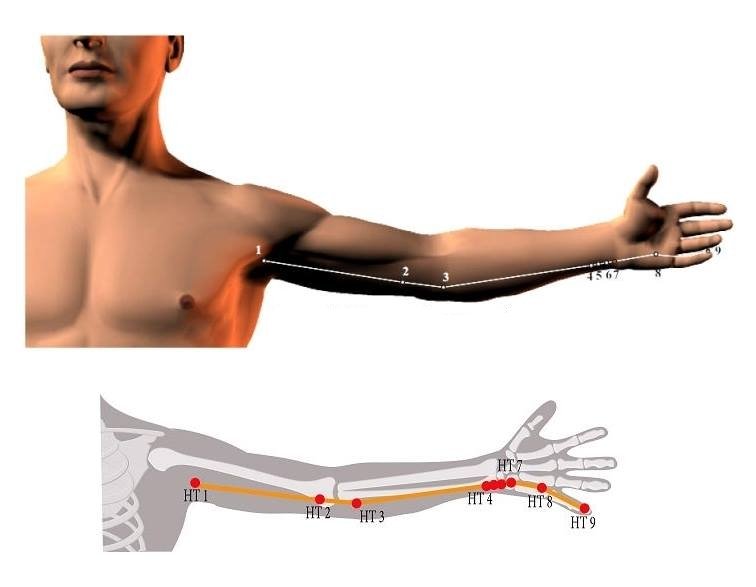
The superficial part of the pathway begins at point HT1 (Jiquan) in the middle of the armpit. From there it descends along the inner side of the upper arm, passes around the elbow and continues along the little-finger side of the forearm across the wrist and palm. It ends at point HT9 (Shaochong) by the nail bed of the little finger, on the side facing the ring finger.
The meridian contains a total of 9 traditionally described points, denoted by the international abbreviation HT (Heart).
Significance of the meridian in Kyusho Jitsu
In Kyusho Jitsu the heart meridian is studied mainly in connection with the anatomy of the upper limbs, the nervous system and the sensitive points in the area of the upper arm, elbow, wrist and hand.
From an anatomical point of view, knowledge of the ulnar nerve (nervus ulnaris), the muscles of the forearm, the tendons and the nerve structures influencing finger mobility and grip strength is particularly important.
Traditionally significant points include, for example, HT3 (Shaohai) in the elbow region, HT7 (Shenmen) at the wrist and HT9 (Shaochong) on the little finger. Studying them involves precise orientation in anatomy, the traditional designation and an understanding of neuromuscular relationships.
In the traditional system of Kyusho Jitsu, the heart meridian is connected with the small intestine meridian, and together they form the Yin–Yang pair of the Fire element.
Traditional characteristics and physical manifestations of imbalance
According to Traditional Chinese Medicine, the heart meridian is associated with blood circulation, mental balance, consciousness and a person's emotional state.
Energetic imbalance of this pathway is traditionally associated with palpitations, unpleasant sensations in the chest, thirst, dryness in the throat, sleep disorders, restlessness, anxious or depressive manifestations and pain along the inner side of the upper limb.
These manifestations derive from traditional teaching and in themselves do not confirm a disturbance of the meridian or any specific disease.
Traditional relationships of the five elements
The heart meridian belongs, together with the small intestine meridian, to the Fire element.
In the generating cycle Fire nourishes Earth, while in the controlling cycle Fire controls Metal.
Spleen–pancreas meridian (SP) – Spleen Meridian
Number of points: 21 (SP1–SP21) on each side of the body
Element: Earth (Yin)
Paired meridian: Stomach (Yang)
Generating element: Metal – Earth nourishes Metal
Controlled element: Water – Earth controls Water
Organ clock: 09:00–11:00
Course of the meridian
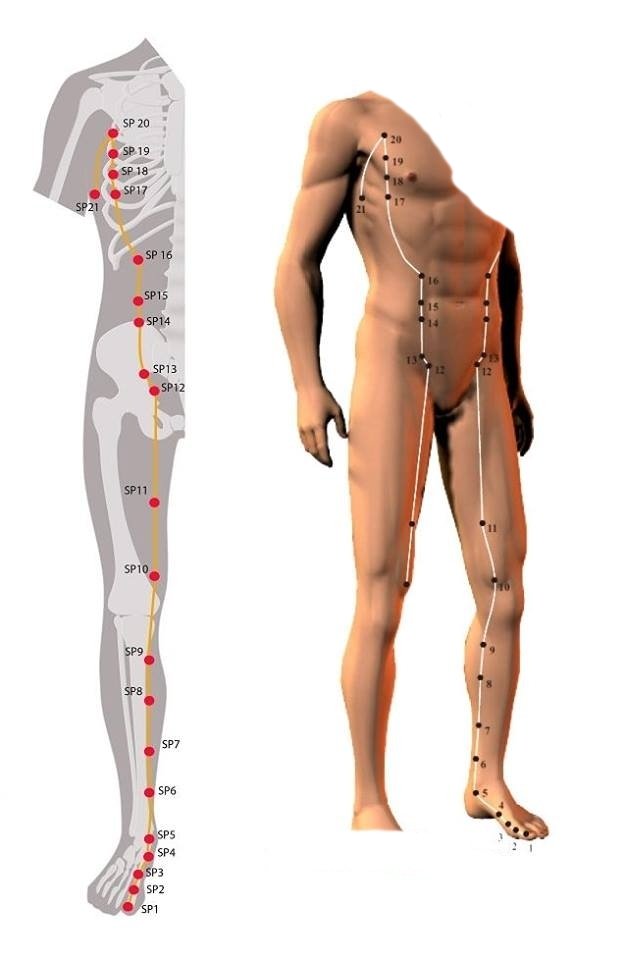
The spleen–pancreas meridian is one of the Yin meridians of the lower limbs. It begins at point SP1 (Yinbai) on the inner edge of the nail bed of the big toe. From there it continues along the inner side of the foot, across the inner ankle and rises further along the inner side of the lower leg and thigh.
It then passes through the groin, lower abdomen and front of the abdomen, from where it continues across the chest. Its superficial course ends at point SP21 (Dabao) on the side of the chest, in the sixth intercostal space.
According to traditional Chinese teaching, the meridian also has internal branches, which are associated with the spleen, the stomach, the diaphragm region, the heart and the root of the tongue.
The pathway contains a total of 21 traditionally described acupuncture points, denoted by the international abbreviation SP (Spleen).
Significance of the meridian in Kyusho Jitsu
In Kyusho Jitsu the spleen–pancreas meridian is significant mainly in the study of sensitive points of the lower limbs, muscle groups, tendons, nerve structures and movement biomechanics.
From an anatomical point of view, it is important to understand the functions of the muscles of the inner thigh, the stability of the knee joint, hip mobility and the transfer of body weight. This knowledge is relevant to the study of balance, control of stance and the movement reactions of the human body.
Well-known points of this meridian include, for example, SP6 (Sanyinjiao), SP9 (Yinlingquan) and SP10 (Xuehai). Kyusho Jitsu studies their traditional location, anatomical context and relationships to the other meridians.
Point SP6 has special significance, where, according to Traditional Chinese Medicine, the three Yin meridians of the lower limbs – spleen, liver and kidney – meet. This connection is part of the advanced study of the traditional relationships between the energy pathways.
Traditional characteristics and physical manifestations of imbalance
According to Traditional Chinese Medicine, the spleen–pancreas meridian is associated primarily with digestion, the transformation and transport of nutrients, muscular activity and the overall vitality of the organism.
Energetic imbalance of this pathway is traditionally associated with loss of appetite, nausea, vomiting, bloating, pain in the stomach and abdomen, intestinal complaints, food hypersensitivity, fatigue, muscle weakness, a feeling of heavy limbs, swelling and pain along the course of the pathway. Problems with the tongue, stage fright, excessive brooding and reduced ability to concentrate are also listed.
These manifestations derive from traditional teaching and in themselves do not confirm a disturbance of the meridian or any specific disease.
Traditional relationships of the five elements
The spleen–pancreas meridian belongs, together with the stomach meridian, to the Earth element.
In the generating cycle Earth nourishes Metal, while in the controlling cycle Earth controls Water.
Urinary bladder meridian (BL) – Bladder Meridian
Number of points: 67 (BL1–BL67) on each side of the body
Element: Water (Yang)
Paired meridian: Kidney (Yin)
Generating element: Wood – Water nourishes Wood
Controlled element: Fire – Water controls Fire
Organ clock: 15:00–17:00
Course of the meridian
The urinary bladder meridian is one of the Yang meridians of the lower limbs and is the longest of the twelve main meridians of Traditional Chinese Medicine.
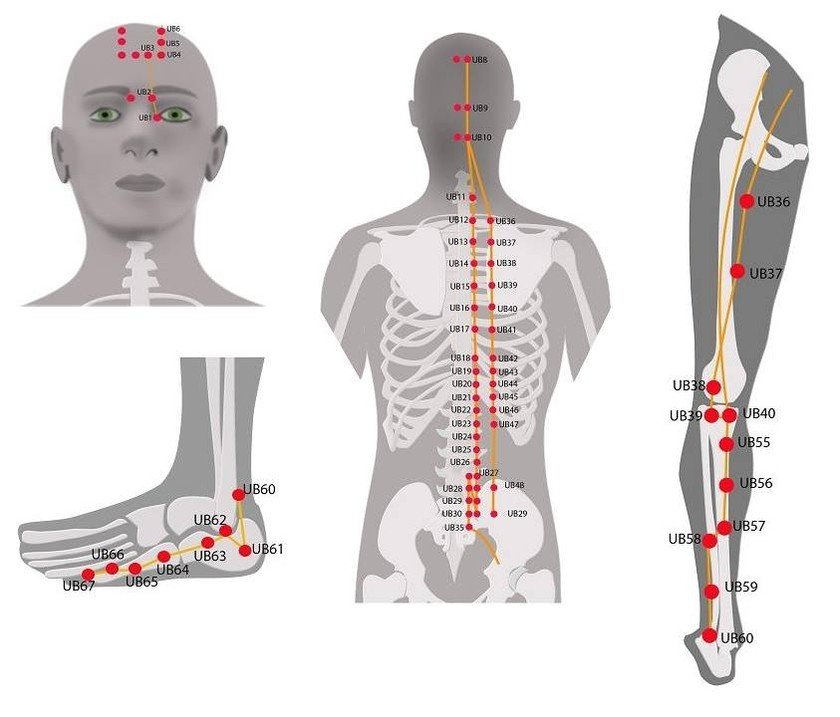
It begins at point BL1 (Jingming) at the inner corner of the eye. From there it rises across the forehead to the crown of the head, continues over the back of the head and the nape towards the spine. In the back region it divides into two parallel branches, which descend along the spine across the thoracic, lumbar and sacral regions.
It then passes through the gluteal muscles, the back of the thighs and the popliteal fossa. It continues along the back of the calf, around the outer ankle and along the outer edge of the foot. It ends at point BL67 (Zhiyin) by the outer edge of the nail bed of the little toe.
The meridian contains a total of 67 traditionally described acupuncture points, denoted by the international abbreviation BL (Bladder).
Significance of the meridian in Kyusho Jitsu
The urinary bladder meridian holds a significant position in Kyusho Jitsu mainly because of its extensive course along the spine and the back of the human body. Its traditional points are located in areas important for posture, stability, balance and coordination of movement.
From an anatomical point of view, knowledge of the spinal muscles, nerve roots, intervertebral structures, the sciatic nerve and the muscle groups of the lower limbs is important.
Well-known points of this meridian include, for example, BL10 (Tianzhu), BL23 (Shenshu), BL40 (Weizhong) and BL60 (Kunlun). In studying them, attention is paid to the traditional location, the relationship to surrounding anatomical structures and their significance in the Kyusho Jitsu system.
The two parallel branches on the back have a special position. In Traditional Chinese Medicine, the so-called Shu transport points, which are associated with the individual organ systems, are located on the inner branch. This connection forms part of the advanced study of traditional meridian relationships.
Traditional characteristics and physical manifestations of imbalance
According to Traditional Chinese Medicine, the urinary bladder meridian is associated with the management of body fluids, the excretion of urine, the activity of the kidneys and the functions of the posterior part of the musculoskeletal system.
Energetic imbalance of this pathway is traditionally associated with urinary disorders, urine retention, pain in the head, nape, back and lumbar spine, pain radiating into the lower limbs, muscle cramps, and some eye and skin complaints. Neuralgic pain, sciatica and breathing difficulties are also listed.
These manifestations derive from traditional teaching and in themselves do not confirm a disturbance of the meridian or any specific disease.
Traditional relationships of the five elements
The urinary bladder meridian belongs, together with the kidney meridian, to the Water element.
In the generating cycle Water nourishes Wood, while in the controlling cycle Water controls Fire.
Pericardium meridian (PC) – Pericardium Meridian
Number of points: 9 (PC1–PC9) on each side of the body
Element: Fire (Yin)
Paired meridian: Triple Energizer (Yang)
Generating element: Earth – Fire nourishes Earth
Controlled element: Metal – Fire controls Metal
Organ clock: 19:00–21:00
Course of the meridian
The pericardium meridian, also called the heart protector meridian, is one of the Yin meridians of the upper limbs. According to Traditional Chinese Medicine, its internal branch begins in the region of the chest and pericardium, from where it descends through the diaphragm and connects with the regions of the Triple Energizer.
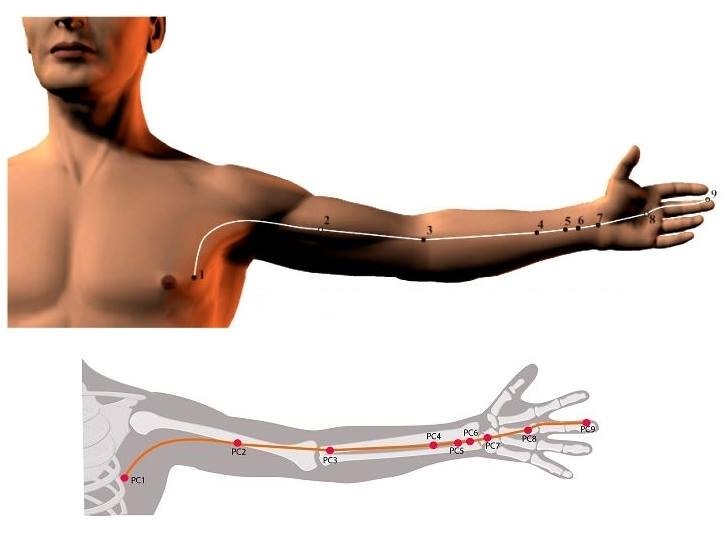
The superficial part begins at point PC1 (Tianchi) on the chest in the fourth intercostal space, approximately one cun lateral to the nipple. From there it continues towards the armpit and descends along the inner front of the upper arm between the heads of the biceps.
It then passes through the cubital fossa, continues along the middle of the palmar side of the forearm between the tendons of the wrist flexors, across the wrist and the centre of the palm to the tip of the middle finger, where it ends at point PC9 (Zhongchong).
The meridian contains a total of 9 traditionally described points, denoted by the international abbreviation PC (Pericardium).
Significance of the meridian in Kyusho Jitsu
In Kyusho Jitsu the pericardium meridian is of interest mainly because of the traditional points located in the area of the chest, upper arm, forearm and palm.
From an anatomical point of view, it is important above all to study the median nerve (nervus medianus), the muscles of the forearm, the tendons of the finger and wrist flexors and the neuromuscular reactions of the upper limb.
Well-known points of this meridian include PC3 (Quze) in the cubital fossa, PC6 (Neiguan) on the inner side of the forearm and PC8 (Laogong) in the palm. In the traditional system of Kyusho Jitsu these points are significant in the study of sensitive spots, their anatomical context and the relationships between the individual meridians.
In traditional teaching the pericardium meridian is also associated with protecting the heart and regulating the inner balance of the organism. In Kyusho Jitsu its connection with the Triple Energizer meridian is studied, with which it forms the Yin–Yang pair of the Fire element.
Traditional characteristics and physical manifestations of imbalance
According to Traditional Chinese Medicine, the pericardium meridian is associated with heart activity, blood circulation, mental balance and the functions of the chest.
Energetic imbalance of this pathway is traditionally associated with restlessness, irritability, sleep disorders, palpitations, unpleasant sensations in the chest, nausea, abdominal pain, muscle cramps and pain in the upper limbs.
These manifestations derive from traditional teaching and are not proof of a disturbance of the meridian or of any specific disease. Chest pain can be a symptom of serious heart disease and requires appropriate medical assessment.
Traditional relationships of the five elements
The pericardium meridian belongs, together with the Triple Energizer meridian, to the Fire element.
In the generating cycle Fire nourishes Earth, while in the controlling cycle Fire controls Metal.