
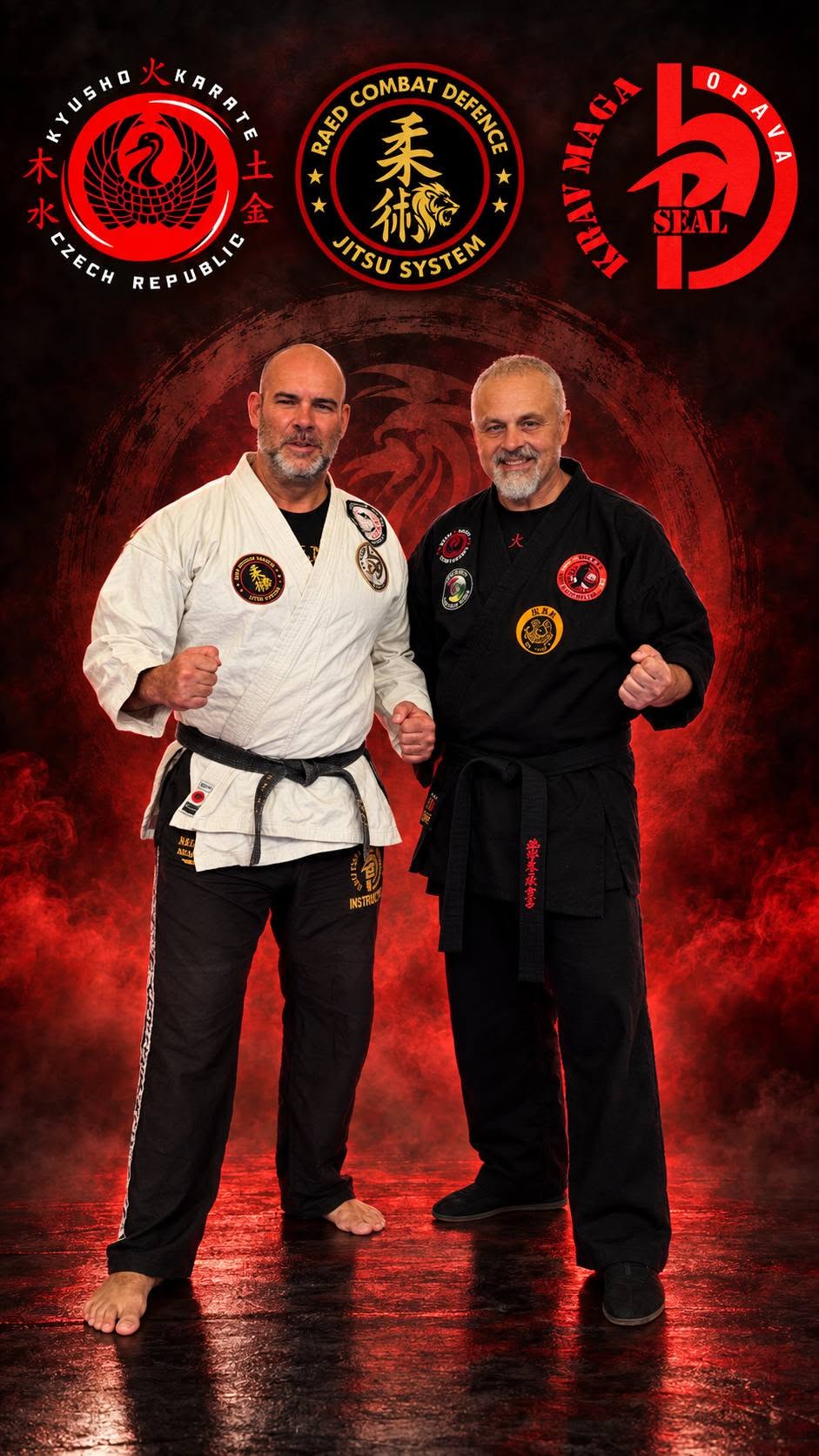
KYUSHO – THE ART OF VITAL POINTS 🥋⚡
Kyusho-Jitsu, or Kyusho for short, is the study of the vital and pressure points of the human body and their use in martial arts, self-defence and work with the human body. It is not a separate fighting style in the usual sense, but above all knowledge that can be applied to the techniques of Krav Maga, Karate, Jiu-Jitsu and other combat systems.
🧠 The intelligent essence of martial arts
Kyusho is often described as “the higher school of martial arts”. While ordinary training teaches how to perform a strike, lock, takedown or other technique, Kyusho goes deeper still – it deals with where, in which direction and at what angle to act, and how the human body reacts to a particular stimulus.
So strength alone is not what matters. What decides the outcome is precision, timing, angle, direction and the right combination of techniques. ⚡
👊 Vital points in combat applications
The human body has sensitive areas connected, among other things, with nerves, muscles and other anatomical structures. Kyusho studies their location and the body's reaction to pressure, grip or strike.
Working correctly with these areas can help, for example, to:
🥋 disrupt the opponent's balance and stance
⚡ provoke a marked pain or reflex reaction
👊 increase the effectiveness of an already familiar technique
🔒 make control, locks or release from a grip easier
🛡️ enable a smaller or physically weaker person to use a technique more effectively against a stronger aggressor
This is precisely one of the greatest strengths of Kyusho – it is not about striking as hard as possible, but about knowing what I am doing and why it works.
☯️ Tradition combined with modern knowledge
The historical principles of Kyusho are associated with traditional Asian martial arts and with the concepts of pressure points also known from acupressure and other traditional systems of working with the body. Modern teaching, however, can supplement these principles with anatomy, physiology, the nervous system and practical testing of individual combat applications.
Kyusho thus makes it possible to look at familiar techniques in a completely different way. A movement that someone has practised for many years can, once they understand work with vital points, acquire a new meaning and further possibilities of use.
🔥 KYUSHO + KRAV MAGA + JIU-JITSU + KARATE
In our approach we do not want to confine Kyusho to a single style. On the contrary, we combine its principles with Krav Maga, Jiu-Jitsu, Karate and practical self-defence.
The same vital point or principle can be used in a strike, in defence against a grip, in a lock, when controlling an opponent or as a complement to a particular self-defence technique.
Kyusho is not about brute force. It is about knowledge of the human body, precision and the ability to apply the right principle at the right moment. 🥋⚡👊
Strength has its limits. Knowledge can overcome them.


Kyusho-Jitsu (Kyusho for short) refers to the vital, or pressure, points on the human body.
The intelligent essence of martial arts. The literal meaning of KYUSHO (Dim Mak / Tsubo / Pressure point)
The essence of KYUSHO jitsu is disrupting, dazzling and stopping the flow of the body's energy by attacking vital points (meridians and some parts or whole nerve pathways) of the body.
Kyusho is rooted in traditional Chinese medicine, such as acupressure, acupuncture or shiatsu, but has a different aim and meaning.
Modern Kyusho is an independent, comprehensive system; an anatomical foundation for every classical martial art.
Kyusho jitsu techniques can be found hidden in all traditional martial arts.
In other words (the university of martial arts), it is a way of manipulating, using and knowing vital points. Knowledge of vital points is used in martial arts, in massage, in healing, in the intimate side of life, in police and special forces, etc. This knowledge of how a person reacts to individual points on the body is based on knowledge of Chinese medicine, which is many thousands of years old.

Learn how to attack the attacker's nervous system effectively, so that you gain an advantage in a fight, reduce the force of an attack and bring the attacker under control, or take them out of the fight altogether. Vital points make use of the nervous system, which this art attacks in a particular way; the angle and direction of the strike or pressure are the most important. Knowledge of vital points not only helps us when an opponent attacks, but is also of benefit in personal life. Individual acupuncture points have a number of other functions besides combat application.
Pressure points can be used, for example, to relieve various subjective health complaints (nausea, headache, musculoskeletal pain, colds, a runny nose, etc.).
If we are to explain well to a beginner or to a student (fighter, athlete) of any combat sport, art or style what Kyusho is, then perhaps the simplest explanation is that it is not some new style or art, but quite the opposite – knowledge that has long been known but forgotten, or deliberately not taught.
Kyusho is a body of knowledge and skills about vital points, which you apply through yourself to your own style, such as Krav Maga, karate, aikido, ju-jitsu, judo, taekwondo, kickboxing, kung-fu, boxing, MMA and others. Thanks to Kyusho you get the answers – where, how and why to strike (the chin, stomach, leg, etc.). To strike with your own technique, and only that, but precisely on a vital point, which makes your style/technique more precise and more efficient.
Kyusho-jitsu is therefore a martial art that is applied to techniques through vital points. For us in the Western world, it can be explained as a parallel between acupuncture and neurology. Kyusho-jitsu (Kyusho) is the use of the effects of vital points, energy, sounds and other knowledge from Chinese medicine (meridians, elements, organ clock, etc.) for a more effective application of points in combat. From the point of view of our Western medicine, we are talking about nerve endings, nerve centres and neurological connections.
The secret of Kyusho lies in the type of stimulation of a point, the angle at which it is sensitive, which combination of points strengthens the resulting effect, the sequence of points, etc. All of this is Kyusho.
Vital points can be divided by function into three categories: paralysing, tactical and lethal (KO). Among the first techniques/points taught in Kyusho is resuscitation, that is, how to help a partner when I cause pain during training (which is part and parcel of every training session). In other words, I know how to relieve and remove pain and, in the case of further consequences, how to help; it is a form of first aid. Considering that training consists of constantly attacking and mastering vital-point techniques, first aid comes first.
Right after first aid, techniques using pressure or a strike on the arms are taught. This is how the first experience is gained, and precision is trained, above all the location of the point, the correct angle of the strike or pressure, and the force/energy I need for it.
For more advanced techniques and a further understanding of the connections in Kyusho, it is necessary to delve deeper into and study the principles of Chinese medicine, by which is meant knowledge of the meridians, the organ clock, the theory of the elements, etc. This knowledge then brings further possibilities and development of Kyusho techniques.
Anyone can begin to study Kyusho; no previous knowledge of medicine or martial arts is necessary. You need to be healthy and fit. Practising Kyusho is not recommended for people suffering from epilepsy or cardiovascular disorders.

Where we train
Opava:
Monday, Wednesday:
Children aged 7 - 14: 16:30 -17:30
Teenagers and adults aged 15 and over: 17:30 - 19:00