
🥋 THE HISTORY OF KYUSHO JITSU
Kyusho Jitsu is a discipline focused on the sensitive and vital areas of the human body and their use in martial arts and self-defence. The word Kyusho (急所) itself denotes an important, sensitive or vulnerable spot.
The principles of working with the vital areas of the human body are not a modern discovery. In various forms they appeared as early as in ancient Asian combat systems and were passed down for generations between teachers and their students.
Okinawa, which became one of the most important places in the formation of Karate, played a significant role in their further development. In the traditional techniques of Karate we can find principles of working with human anatomy, sensitive areas of the body, balance, and the direction and angle of action.
Knowledge of these applications was historically often passed on only within particular schools and among a limited circle of students. With the gradual development of modern martial arts and sport Karate, part of the original practical applications also receded into the background.
Today Kyusho seeks to study these principles anew, understand them and connect the traditional knowledge of martial arts with a contemporary view of anatomy, biomechanics and the reactions of the human body.
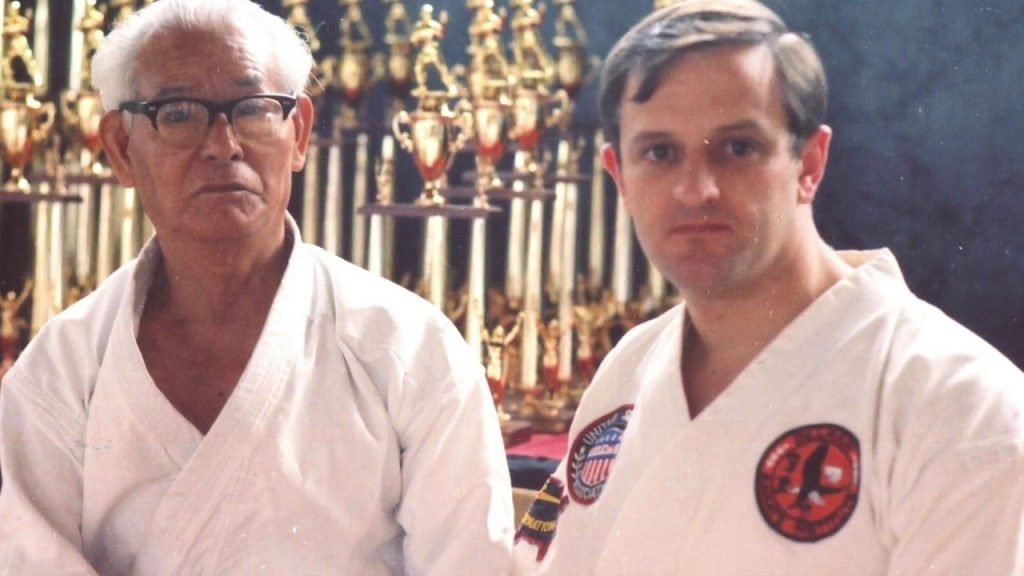
In the photograph:
Soke Hohan Soken and George A. Dillman
An important figure who influenced the later direction of George A. Dillman was the Okinawan master Hohan Soken (1889–1982), a representative of traditional Okinawan karate and the Matsumura Seito Shorin-Ryu system.
George Dillman met Hohan Soken during his study of Okinawan martial arts. It was his contacts with Okinawan masters that gradually led Dillman to a deeper study of the original applications of karate, work with vital points and the meaning of techniques hidden in traditional forms.
An important milestone on his further path was also meeting Seiyu Oyata, who devoted himself to Ryukyu Kempo and to the knowledge known as Kyusho Jitsu and Tuite Jitsu – that is, work with the sensitive areas of the human body, joints, grips and control techniques.
These experiences later became one of the foundations of Dillman's further research and systematic study of vital points.
GEORGE A. DILLMAN AND THE MODERN DEVELOPMENT OF KYUSHO
George A. Dillman is among the most significant figures who contributed to the modern spread of Kyusho Jitsu and the study of vital points in martial arts.
He built on the experience gained from Okinawan masters through long-term study, research and practical verification of individual principles. He gradually systematised his findings and began to pass them on through seminars, teaching, books and other educational materials.
In doing so he contributed significantly to the spread of Kyusho among martial arts practitioners, not only in the USA but later also in Europe and other parts of the world.
DILLMAN KARATE INTERNATIONAL – DKI
George A. Dillman built the international organisation Dillman Karate International (DKI), through which his approach to Kyusho, work with vital points and the application of traditional combat techniques spread further among instructors and schools in various countries around the world.
It was through this international line that Kyusho later came more prominently to Europe and subsequently to the Czech Republic.
Official website of Dillman Karate International:
https://www.dillman.com/

In the photographs from the left: Wakinaguri no Tanmei – Taika Seiyu Oyata – Uhugushiku no Tanmei.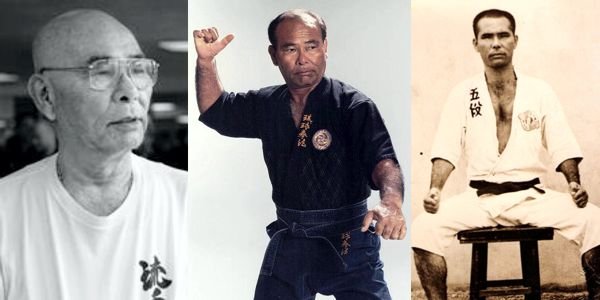
Taika Seiyu Oyata (1928–2012) is among the key figures in the modern history of Kyusho. Alongside his study of Okinawan Karate, he gained advanced knowledge from his teachers Wakinaguri and Uhugushiku. In his teaching he placed great emphasis on the practical interpretation of kata, work with the sensitive areas of the human body and Tuite control techniques. It was meeting and studying with Seiyu Oyata that also strongly influenced the further path of George A. Dillman and his interest in deeper applications of traditional techniques. OyataTe International
🇺🇸➡️🇬🇧 KYUSHO SPREADS TO EUROPE
With the growth of Dillman Karate International (DKI), knowledge of Kyusho Jitsu and work with vital points gradually spread from the United States to Europe as well. A new generation of instructors emerged who went on to study these principles, develop them and incorporate them into their martial arts.
One of the significant figures of this European line is the British master Paul Bowman, whose journey through martial arts spans several decades. Studying Kyusho under George A. Dillman fundamentally influenced his further direction and the way in which he began to look for a deeper meaning in traditional combat techniques.
🇬🇧 PAUL BOWMAN – ZENDORYU MARTIAL ARTS
Paul Bowman gradually created Zendoryu Martial Arts, in which he combines many years of martial arts experience with the study of Kyusho and practical applications of traditional techniques.
Zendoryu subsequently became an important link in the European development of this line, and it is through Paul Bowman and Zendoryu Martial Arts that a direct connection also leads to the Czech Republic.

Official website of Zendoryu Martial Arts:
https://www.zendoryumartialartshq.com/

🇨🇿 KYUSHO IN THE CZECH REPUBLIC
In the Czech Republic too, Kyusho has gradually developed through various instructors, schools and international organisations. It is therefore important to stress that Czech Kyusho is not made up of a single organisation or a single teaching line.
One of the significant branches is the line that follows George A. Dillman and Dillman Karate International (DKI), which continues through Paul Bowman and Zendoryu Martial Arts to the Czech Republic.
🥋 KYUSHO KARATE CZECH REPUBLIC
A significant figure of this line in the Czech Republic is Ing. Zdeněk Dvořák, a long-time practitioner and teacher of martial arts who studies Kyusho under Paul Bowman.
His many years of activity are continued by Kyusho Karate Czech Republic, which is devoted to the systematic study of vital points, their applications in combat techniques and the education of further students and instructors.
This activity includes regular training sessions, seminars, the Kyusho Karate Academy and cooperation with instructors from abroad.

Official website of Kyusho Karate Czech Republic:
https://kyushokarate.cz/
DIFFERENT LINES – A COMMON PRINCIPLE
Alongside this branch there are also other instructors, schools and international lines of Kyusho active in the Czech Republic. The individual directions may differ in teaching methodology, terminology or manner of application.
What matters most to us is to study, educate ourselves, get to know different approaches and look for their functional use in martial arts and practical self-defence.